Codex or Claude Code? Choose the Workflow
On this page
The Useful Answer Is Workflow First
Teams often ask which coding agent is better: Codex or Claude Code. The question is understandable, but it is not the best first question.
For real software work, the outcome is shaped by the workflow around the model: how the task is framed, what repository context is available, whether work is isolated, how findings are verified, and how humans review the final change.
Quick Answer
| If your team needs... | Start with this workflow decision |
|---|---|
| Small scoped fixes | one agent, one branch, explicit tests |
| Cross-file product work | issue first, architecture slice, focused validation |
| Large migration or audit | parallel subagents with isolated scopes and merge review |
| Enterprise rollout | permissions, secrets, audit logs, and rollback before autonomy |
Practice path in AIErudit:
- Builders: Full-Stack Developer with AI
- Repo/process owners: Git, GitHub & Worktrees for AI Teams
- Claude operators: Claude 101
- AI architecture reviewers: Claude Certified Architect Foundations
The Wrong Comparison
A simple feature table can be useful for procurement, but it rarely predicts delivery quality.
The same agent can produce excellent work in a well-prepared repository and weak work in a chaotic one. A powerful model can still fail if it does not know the project contract, cannot run the right checks, or is asked to edit too many files without boundaries.
So compare tools through the operating system around them.
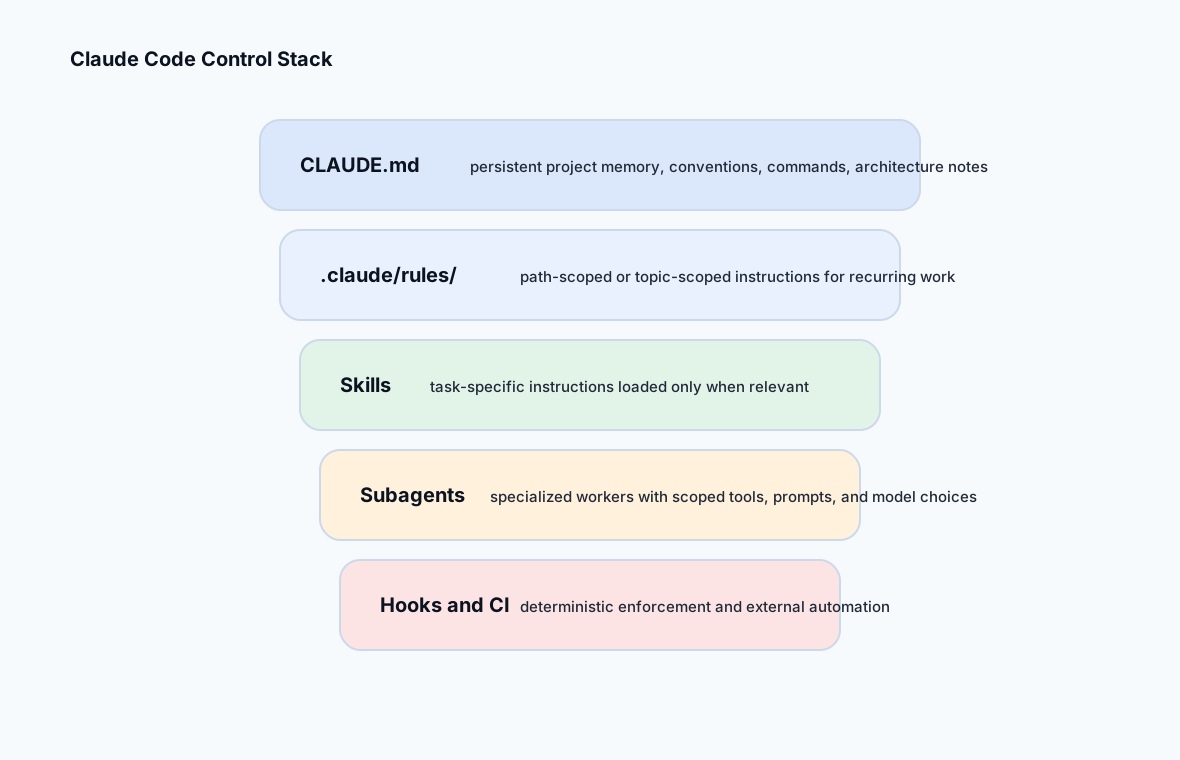
Diagram
Article diagram
What Codex Is Good For
OpenAI positions Codex as a coding agent surface for understanding codebases, writing code, reviewing changes, debugging, and automating development tasks. That makes it especially useful when the work benefits from local repository context, explicit instructions, repeatable shell commands, and a clean review trail.
Codex fits best when the task can be expressed as a concrete engineering loop:
- inspect the codebase;
- make a bounded change;
- run focused validation;
- report exact files and residual risk;
- open a reviewable PR.
That loop is valuable for bugs, refactors, tests, documentation tied to code, and production hardening where evidence matters more than a polished answer.
What Claude Code Is Good For
Anthropic's engineering writing emphasizes agent loops, tool access, context engineering, subagents, compaction, and verification. Claude Code also has a strong narrative around dynamic workflows: for larger work, Claude can create orchestration scripts and run many parallel subagents, then check the result before handing work back.
That points to a different strength: Claude Code is compelling when the work is broad enough to benefit from dynamic planning, subagent decomposition, and long-running harness design.
Use this lens:
| Work shape | Prefer |
|---|---|
| One issue, tight patch, explicit local validation | Codex-style branch agent |
| Large codebase audit, many independent lanes | dynamic workflow / subagent orchestration |
| Learning how agentic coding changes delivery | compare both inside the same repo contract |
| Enterprise adoption | whichever tool can satisfy permissions, logging, and review constraints |
The Repo Contract Matters More Than The Tool
Agentic coding works best when the repository is ready for agents. That means:
- task tickets include acceptance criteria and required regression coverage;
- architecture boundaries are machine-checkable;
- tests can run locally and in CI without secret-dependent surprises;
- code owners know who reviews which surface;
- branch isolation prevents one experiment from polluting another;
- validation commands are documented where agents can find them.
Without this, the agent must infer the rules. That is where many failures begin.
Security Is A Workflow Property
The enterprise question is not only "Can this agent code?" It is "How far can a bad action travel?"
Anthropic's containment writing frames agent risk through blast radius: as agents receive more access, engineering teams must cap the damage a failure can cause. In coding workflows, that maps directly to:
- read/write permissions;
- secret exposure rules;
- branch and worktree isolation;
- human approval gates;
- audit logs;
- rollback plans;
- limits on autonomous tool use.
The safer workflow is often the one that gives the agent enough authority to be useful and no more.
A Practical Selection Matrix
Use this before choosing a coding agent setup.
| Question | Why it matters |
|---|---|
| What exact outcome is expected? | Prevents broad "make it better" tasks. |
| Which files or modules are in scope? | Limits accidental cross-surface edits. |
| What validation proves the change? | Makes "done" measurable. |
| What must never be exposed or changed? | Protects secrets, auth, payments, and user data. |
| Can the work split safely? | Determines whether subagents help or create merge risk. |
| Who owns final review? | Keeps accountability human. |
AIErudit Practice Path
For developers, start with Full-Stack Developer with AI and use Git, GitHub & Worktrees for AI Teams to make agent work reviewable. If you operate Claude-heavy workflows, add Claude 101. If you review architecture and tool-risk decisions, add Claude Certified Architect Foundations.
The goal is not to pick a permanent winner. The goal is to build a coding workflow where agents produce evidence, humans can review it, and the repository stays healthy.
Continue learning with these courses
Sources and Further Reading
- OpenAI Codex documentationdevelopers.openai.com
- Building agents with the Claude Agent SDKclaude.com
- Introducing dynamic workflows in Claude Codeclaude.com
- Effective harnesses for long-running agentsanthropic.com
- How we contain Claude across productsanthropic.com
Stay ahead with AI insights
Get practical AI tips, new course announcements, and career strategies delivered weekly.