Why Agentic AI Pilots Fail Before Production
On this page
The Demo Is Not The Operating Model
Agent demos are easy to love. A model plans a task, calls a tool, writes a summary, and looks like it compressed a week of work into minutes.
The problem starts after the demo, when the same idea has to operate inside a real business process. Production does not reward impressive one-off behavior. It rewards controlled, repeatable, measurable behavior.
Practice path in AIErudit:
- CTOs and delivery leads: AI Delivery Systems
- Risk and governance owners: AI Governance, Risk, and Secure Operations
- Evals owners: AI Evals, Observability, and Red Teaming
- Product leaders: AI for PMs and AI for CTOs
The Demo-To-Production Gap
Analyst and consulting research points in the same direction: organizations are using AI widely, but scaled enterprise impact is uneven. McKinsey's State of AI work describes broad regular AI use while also noting that many organizations remain short of workflow-level transformation. Gartner frames agentic AI through a hype-cycle lens and highlights execution concerns such as governance, security, and cost management.
That gap is where many pilots die.
They do not fail because the demo was fake. They fail because the pilot was never converted into an operating system.
Five Reasons Pilots Stall
1. The workflow was never redesigned
Many pilots automate a task without redesigning the workflow around it. That creates a fragile handoff: the agent produces an output, but the organization has no clear route for approval, exception handling, audit, or feedback.
An agent that drafts procurement analysis still needs data access rules, buyer review, vendor-risk policy, approval thresholds, and a way to handle missing evidence. Without those boundaries, the pilot is a clever assistant, not a production capability.
2. The data layer is not ready
Agents need context. In production, context means current, permission-aware, well-scoped data. Many pilots use curated examples, copied documents, or a narrow sandbox. Production needs stronger answers:
- What data can the agent access?
- Which system is authoritative?
- How are permissions enforced?
- How is stale context detected?
- What happens when retrieval returns conflicting evidence?
If the data layer is weak, the model is forced to guess or overgeneralize.
3. Evaluation is treated as an afterthought
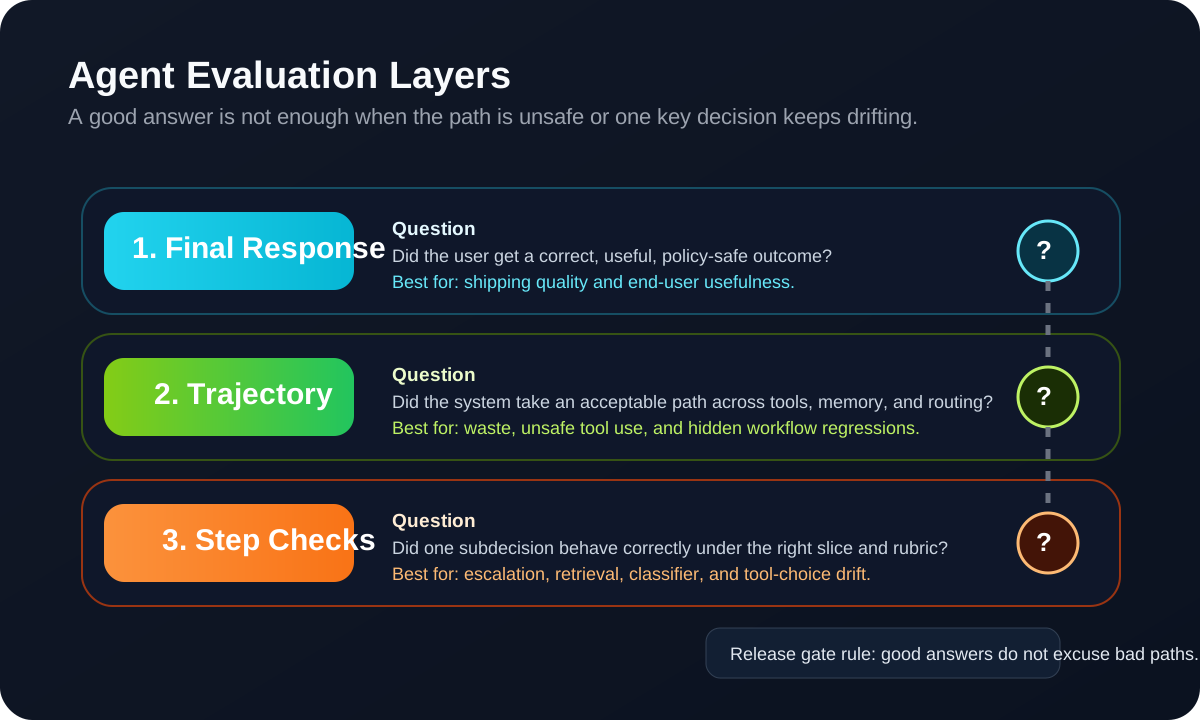
Teams often validate pilots with a few happy-path examples. That is not enough. Agentic workflows need evaluations across intent, tool use, retrieval quality, output quality, safety, and cost.
Diagram
Article diagram
The loop matters. Production behavior changes as prompts, tools, models, data, and user behavior change. Evaluation is not a launch task. It is an operating practice.
4. Governance is bolted on too late
The more autonomous an agent becomes, the more governance must move upstream. A production agent should have explicit limits:
- what it can read;
- what it can write;
- which actions require human approval;
- how decisions are logged;
- when it must escalate;
- how costs are controlled.
This is not paperwork. It is the difference between a useful workflow and an unmanaged automation surface.
5. Ownership is unclear
A pilot can survive with one enthusiastic champion. Production cannot.
Every production agent needs owners for:
- business outcome;
- data access;
- prompt and context changes;
- evaluation suite;
- model and tool configuration;
- incident response;
- user training.
If no one owns the full operating loop, the system becomes hard to trust and harder to improve.
A Production Readiness Model
Use this maturity ladder before promoting an agent pilot.
| Stage | What exists | What is still missing |
|---|---|---|
| Demo | One impressive scenario | Real data, edge cases, governance |
| Pilot | Limited users and scoped data | Evaluation depth, operational ownership |
| Controlled workflow | Human-reviewed outputs and logging | Scaled monitoring, cost controls |
| Governed production | Release gates, evals, permissions, incident playbook | Continuous optimization |
The jump from pilot to production is not a bigger prompt. It is a stronger system.
The Minimum Production Checklist
Before a pilot graduates, answer these questions:
- What business decision or workflow does the agent improve?
- What is the baseline without the agent?
- What data can the agent access, and why?
- What actions are read-only, suggested, or autonomous?
- What are the top five failure modes?
- Which evaluation set catches those failures?
- Who reviews changes to prompts, tools, and retrieval?
- What is the rollback plan?
- What cost threshold triggers review?
- How will users report bad outputs?
If the team cannot answer these, the pilot may still be valuable, but it is not production-ready.
Which Next Step Fits You?
| You own... | Build this capability | AIErudit route |
|---|---|---|
| Delivery and release | evaluation-backed AI delivery loop | AI Delivery Systems |
| Risk and approval | governance, access, logging, escalation | AI Governance, Risk, and Secure Operations |
| Quality and regression | datasets, traces, scorers, red-team cases | AI Evals, Observability, and Red Teaming |
| Product roadmap | baseline, user value, rollout shape | AI for PMs |
| Technical strategy | architecture, vendor risk, operating model | AI for CTOs |
The winning teams will not be the ones with the flashiest demo. They will be the ones that can operate AI systems safely after the demo ends.
Continue learning with these courses
Sources and Further Reading
- Gartner: 2026 Hype Cycle for Agentic AIgartner.com
- McKinsey: The State of AImckinsey.com
- McKinsey: Building the foundations for agentic AI at scalemckinsey.com
- Deloitte: Agentic AI strategydeloitte.com
- Demystifying evals for AI agentsanthropic.com
- How we contain Claude across productsanthropic.com
Stay ahead with AI insights
Get practical AI tips, new course announcements, and career strategies delivered weekly.